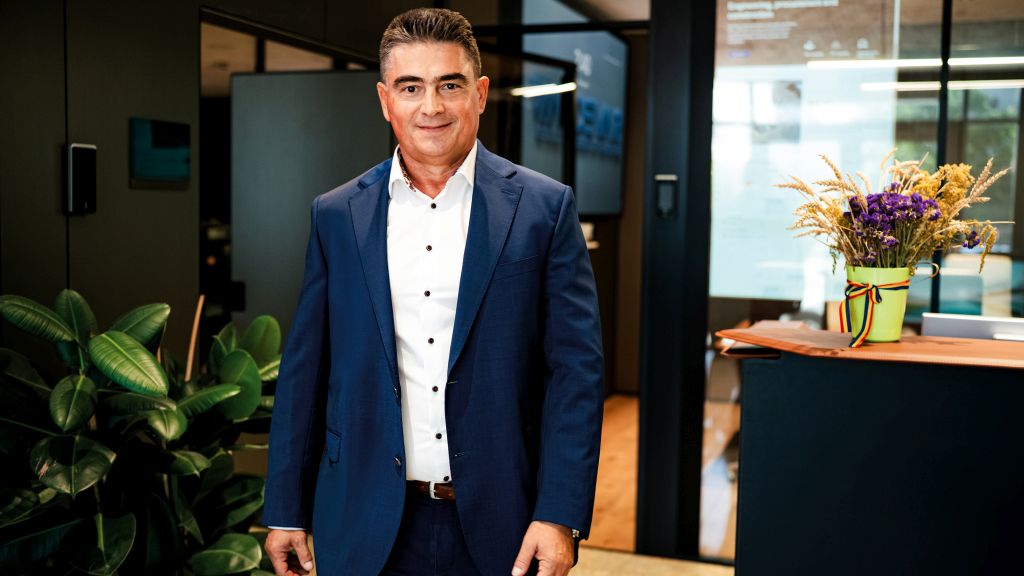
Raiffeisen Bank chief economist Dumitru: I favour the euro switchover schedule being kept in force
AGERPRES - Romanian News Agency - 4 Mai 2009
The schedule for Romania's switchover to the single European currency should be kept in place, and the advantages and disadvantages of a faster switchover should be carefully weighed in, Raiffeisen Bank Chief Economist Ionut Dumitru told the first session on Thursday of a symposium on realities and illusions amidst economic crisis, organised by the National Bank of Romania (BNR).
Dumitru said that the arguments in favour of a faster switchover point to a high degree of euroisation of the Romanian economy, forex risks generated by a high forex indebtedness rate, as well as to the commercial ties with the Eurozone. He argued that postponing the switchover reduces the incentives for carrying our structural reforms.
Among the contrary arguments, Dumitru mentioned the rigidity of the local labour market, an economic cycle that is weakly correlated with the Eurozone, a large current-account deficit, which has to be corrected before Romania may join the Eurozone, major delays in the implementation of structural reforms that have to be adopted before the switchover, as well as faulty public finance sustainability.
Dumitru said that Government deficit will not be easy to correct.
He added that in order to secures sustainability for Romania's switchover to the euro, in terms of real and nominal convergence, a mix of economic policies is required that should be more adequate for correcting economic imbalances, measures to boost productivity, such as infrastructure investment policies, a more realistic revenues policy, particularly for the public sector, as well as the reforming of the public administration, the healthcare sector, the education system and boosting flexibility for the labour market.
'The rigidity of the Romanian labour market is the highest in the European Union, but is has been noticed that this is a problem facing all the EU newcomers. Particularly, this is a rigidity of the local labour market because people are tied to their homes, which decrease mobility,' Dumitru explained, mentioning that the labour market could act as a shock absorber.
Referring to the synchronisation of economic cycles, Dumitru showed that Romania's correlation with the economic cycles of the EU is among the lowest in the EU.
Dumitru also said that the economic structure of Romania is different from that of the Eurozone.
'Romania has a share of the agriculture in the industry that is higher than in other European Union member states, and agricultural productivity is quite small and requiring large investments,' Dumitru pointed out.
As regards Romania's commercial integration, the openness of the Romanian economy is not so wide, which provides it with protection. It is far below that of neighbouring countries, and with all its advancement of late it is still far from what it should be.
When it comes to institutional convergence, said Dumitru Romania is again not where it should be, but it is lagging behind in the EU.
The per-capita Gross Domestic Product (GDP) in Romania is far from what it is in the Eurozone and Romania has to travel a very long way before reaching real convergence.
Dumitru said that Romania still fares better as far as the foreign exchange rate against the euro is concerned, even better that Hungary and Poland when it comes to exchange rate volatility.
According to the schedule for the switchover to the euro, which BNR believes to be reasonable, Romania should join the Exchange Rate Mechanism (ERM 2) in 2012 and switch over to the single European currency on January 1, 2015.
Sursa: http://www.rompress.ro
Tags: dumitru
romania
eurozone
labour
market
economic
euro
switchover
schedule
should
bnr
Articole similare
facebook
twitter
linkedin
youtube
rss
newsletter